The Great Lie
We walk around alienated from ourselves and each other, confusing universal needs with fleeting strategies. The myth of the rugged individual breeds spiritual hunger and chronic anxiety.
These are not rules. They are commitments: to the work, to the body, and to each person who enters this space. They evolved from practice, not theory. They continue to evolve.
This is a living philosophy. It is not a manifesto written once and sealed. It grew from hundreds of sessions, dozens of classes, and years of listening to what the body teaches when you let it speak.
Each doctrine below names something this practice holds as non-negotiable. These are commitments, not dogma. Read them as a practitioner. Test them against your own experience. If they land, they were already yours.
Four movements trace the work: rupture, the body as altar, the eightfold path of transcendence, and the final tie. Read the map top to bottom. Return to it as the doctrines below unfold.
The Primer. Strip bare and step into the flame.
We walk around alienated from ourselves and each other, confusing universal needs with fleeting strategies. The myth of the rugged individual breeds spiritual hunger and chronic anxiety.
A deliberate, ritualized path to shatter illusion and reclaim your primal, sovereign self. Not light play. Initiation.
When the body stops resisting and starts listening, truth becomes unbound. The rope is a mirror, a threshold, a teacher.
The body is the first temple. The nervous system is the oldest scripture.
A lineage of seekers, healers, and artists blending Tantra, BDSM, mindfulness, magick, and ritual into a sanctuary where the taboo becomes sacred. Belonging is earned through alignment, discipline, and devotion.
Without consent, there is no magick. Safety is not the absence of risk. It is the discipline of meeting reality with preparation. The pact, once entered, is blood-bound.
Memory lives in fascia. Posture encodes history. Rope, compression, and tension are neurological tools. The body cannot be negotiated with from the outside; it must be convinced in real time.
Ordeal. Dissolution. Rebirth.
Pain is not punishment. It is a technology that overloads the ego's defenses and forces a biological reset. Breathe into sensation. Sacrificial surrender becomes sacrament.
Nihilomancy is divination by nothingness, starving the brain's orientation center until pure receptivity remains. Sex Magick then pressurizes the current through the rope into Eroto-Comatose Lucidity. The void dissolves. The flesh imprints.
The shadow is not a trash heap. It is a vault of exiled vitality. This tradition does not banish darkness. It marries it. Capable of force, guided by love.
Integration. Embodied liberation. Authorship.
The ordeal does not end when the rope releases. It ends when the nervous system metabolizes the intensity. The Final Tie is not a knot on the body. It is the internal act of binding the fragmented psyche into a unified whole.
Having survived the ordeal, you stop being the protagonist and become the Author. The myth you lived before was written by others. Claim the Mythology of the Self and stop being a passive recipient of fate.
The rigger is speaking to the body. And the body speaks back: through breath, through resistance, through surrender, through stillness.
This practice treats rope as dialogue. The tie is a question. The body's response is the answer. The rigger's next move is a response to that answer. This is not a metaphor. It is literally how the work moves.
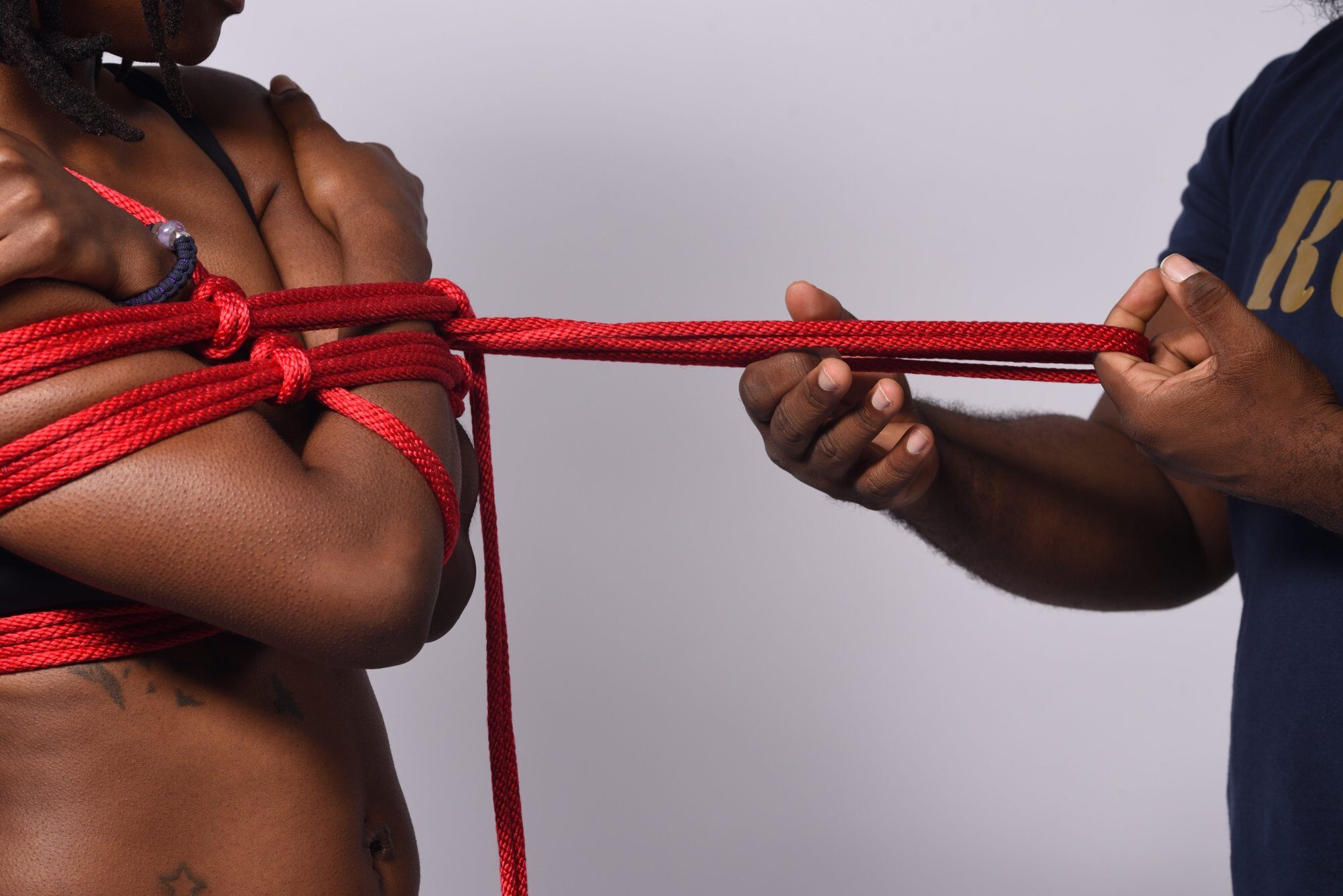
The tie is a question. The body's response is the answer.
If you are not listening, you are not tying. You are just applying rope.
A signed form is not consent. A "yes" at the beginning is not consent for the duration. Consent is a living state: it shifts, deepens, contracts, and sometimes withdraws. A practitioner who treats consent as a box to check is not practicing consent at all.
In this work, consent is checked continuously. Through attention, not interruption. The rigger reads the body's signals: breath pattern, muscle tone, facial expression, the quality of silence. When something shifts, the work pauses. The body has new information.
This is why the intake is detailed. It begins a conversation that continues through every moment of the session and beyond.

Consent is checked continuously. Through attention, not interruption.
The most dangerous rigger is the one who believes that initial consent covers everything. The safest rigger is the one who knows it covers nothing, and stays present anyway.
The nervous system does not wait for the mind's permission. When the body is held in rope, it begins to process: releasing stored tension, surfacing emotions, recalibrating its sense of safety. This happens at a speed and depth that cognition cannot match.
A person in rope may cry without knowing why. May laugh. May feel a wave of grief for something they haven't thought about in years. This is not a malfunction. This is the body doing what it was designed to do when given the conditions to do it: container, presence, witness.
The practitioner's role is not to interpret what arises. It is to hold space for it. The body knows what it is doing. Trust it.

The body knows what it is doing. Trust it.
You do not need to understand what is happening in your body for it to be real. You only need to let it happen.
Intensity is not the enemy. Carelessness is. A deep tie, a long hold, an emotional release: these are not dangerous because they are intense. They are dangerous when the person holding the space is not fully present.
Presence means: I see you. I feel the rope. I notice the shift in your breathing. I am not thinking about the next tie or the one after that. I am here, in this wrap, in this moment, with you.
This is why preparation matters. Why the warmup is not optional. Why the environment is set with intention. Intensity without presence is recklessness. Intensity with presence is where the deepest work lives.

Intensity without presence is recklessness. Intensity with presence is where the deepest work lives.
If the rigger is performing, the bunny is alone. If the rigger is present, the bunny is held. The difference is not visible from outside. It is felt in every fiber of the rope.
The culture tells us that value lives in action. Movement. Productivity. Force. In this work, the opposite is true. The most transformative moment in a session is often the moment when nothing is happening: the rope is set, the body is held, and the only movement is breath.
Stillness is not the absence of doing. It is the deepest form of participation. It requires more trust than struggle, more courage than performance. To be held, truly held, and to stay present in that holding, without escaping into thought or narrative or control, is the hardest thing most people will ever do in rope.
This is where the work lives. Not in the knot. In the quiet after.
 Stillness · Presence · Listening
Suspension is not about being lifted. It is about being still enough to feel what gravity has always been saying.
This practice is rooted in Black experience, Black embodiment, and Black spiritual tradition. That is not a disclaimer. It is the foundation.
The body that enters this work carries history: cultural, ancestral, personal. For Black bodies in particular, the act of being bound and choosing to trust is not neutral. It carries weight. It carries memory. And it carries the possibility of reclamation: to choose surrender on your own terms, in a space built by someone who understands what that choice costs and what it can return.
This is not a practice that happens to be led by a Black man. It is a practice shaped by Blackness: by the rhythms, the spirituality, the resilience, and the sacred irreverence that Black culture holds. That centering is not negotiable. It is not performative. It is the ground the work stands on.

It is the ground the work stands on.
We do not ask permission to center ourselves in our own practice. We build from where we stand.
These posts explore the ideas above in practice.
These doctrines are not finished. They are tested in every session, refined in every class, challenged by every body that enters the work. If you have read this far and something in you responded, then this work may be for you.
Come with honesty. Come with curiosity. Come ready to feel. The rope will meet you where you are.
Ashe.Formspree submission
Complete the form and submit without leaving this page.